

Motorhome Speed Limits: What the Law Says in France and Europe
Motorhome Speed Limits: What the Law Says in France and Europe
Whether you’re planning a weekend in Brittany with your converted van or a road trip to Spain, the question often comes up: how fast are you allowed to drive? In France, a motorhome under 3.5 tonnes is limited to 120 km/h on motorways. On main roads, the limit is 80 km/h, and in towns, it drops to 50 km/h. For vehicles over 3.5 t, the limit falls to 100 km/h on motorways, just like for HGVs.
These rules apply to both new models and converted vans with VASP approval. They also vary across European countries. If you’re towing a trailer, the limits drop even further. For a combined weight of 3.5 t or less, the maximum speed is 90 km/h on motorways. Above that, it’s 80 km/h. Watch out for pitfalls: a speed limit sticker is mandatory for motorhomes over 3.5 t. Without one, you risk a fine.
Motorhome Speed Limits in France: Rules by Weight
In France, a motorhome’s speed limit depends on its maximum authorised mass (PTAC). This weight is shown on the vehicle registration document (carte grise), under section F2. There are two scenarios:
| Motorhome PTAC | Motorway | Dual-carriageway | Town |
| ≤ 3.5 t | 120 km/h | 80 km/h | 50 km/h |
| > 3.5 t | 100 km/h | 80 km/h | 50 km/h |
These limits also apply to converted vans with VASP approval. To qualify, the conversion must be fixed—permanent features like a bed, kitchen or storage are required. A van with a basic, removable conversion (dismantled in under two hours) remains classified as CTTE and follows the same rules as a light vehicle. For example, a Citroën Berlingo fitted with a portable kitchenette and foldaway bed doesn’t need VASP approval and can travel at 120 km/h on motorways.
A category B licence is sufficient for towing a trailer if the combined weight doesn’t exceed 3.5 t. Above that, a BE licence or B96 endorsement is required. Here are the speed limits when towing:
- 90 km/h on motorways for a combined weight of ≤ 3.5 t;
- 80 km/h on motorways for a combined weight of > 3.5 t;
- 80 km/h on main roads, regardless of weight.
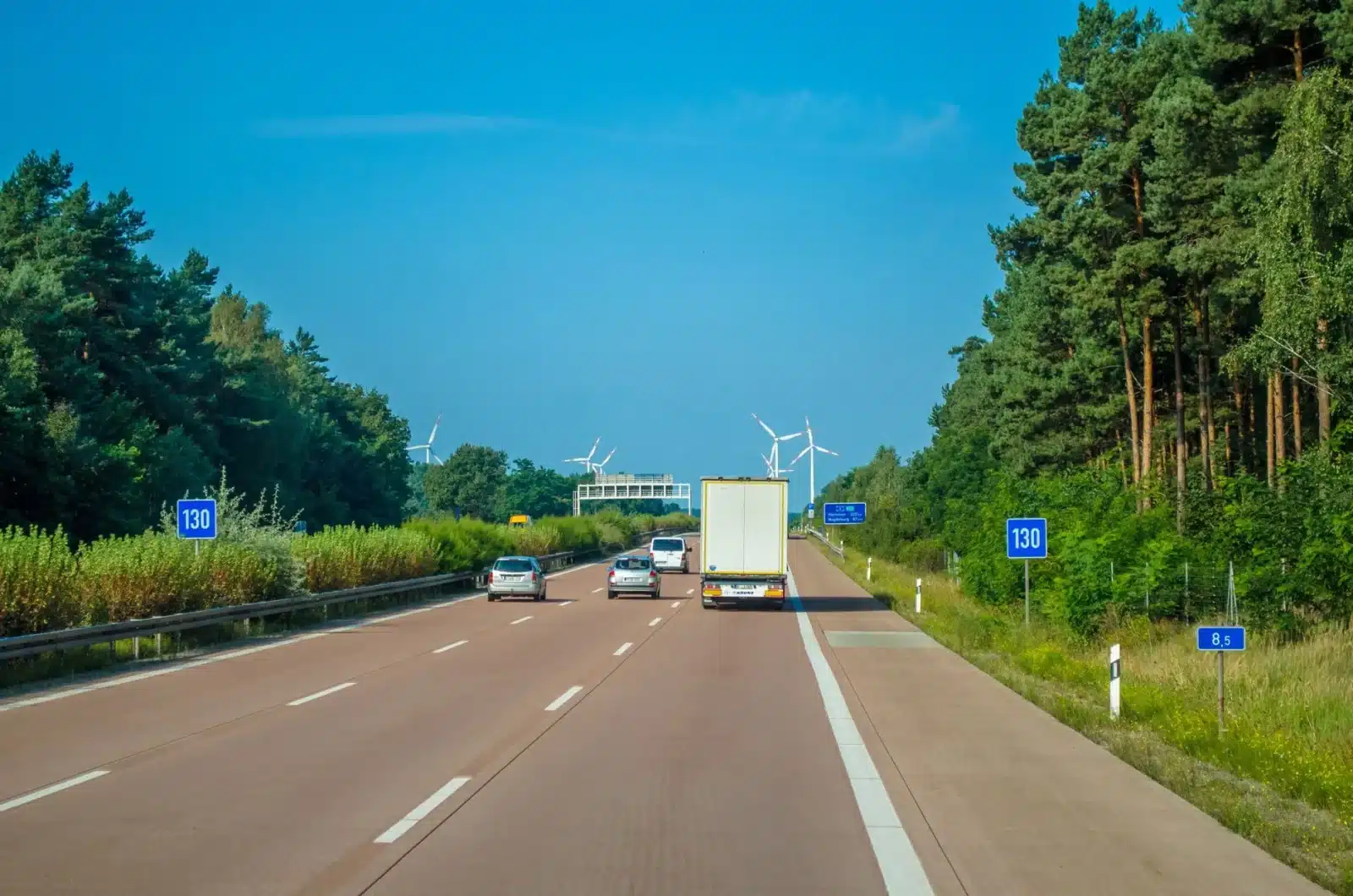
Motorhome Speed Limits in Europe: Country-by-Country Differences
Rules vary from country to country. Here are the limits for motorhomes under 3.5 t. Heavier models generally follow the same rules as in France, with local variations.
| Country | Motorway | Dual-carriageway | Town |
| Spain | 120 km/h | 90 km/h | 50 km/h |
| Germany | No limit on some sections (recommended: 130 km/h) | 100 km/h | 50 km/h |
| Portugal | 120 km/h | 90 km/h | 50 km/h |
| Italy | 130 km/h (110 km/h in rain) | 90 km/h | 50 km/h |
| Belgium | 120 km/h | 90 km/h | 50 km/h |
In Spain, motorhomes over 3.5 t are limited to 90 km/h on motorways and 80 km/h on main roads. In Germany, some motorway sections have no speed limit, though a recommended speed of 130 km/h applies. When towing a trailer, limits often drop by 10 to 20 km/h. For example, in Spain, a 3.5 t motorhome with a trailer cannot exceed 80 km/h on motorways.
Speed Limit Sticker: Mandatory for Motorhomes Over 3.5 t?
In France, motorhomes over 3.5 t must display a speed limit sticker at the rear. This sticker shows 100 km/h and must be clearly visible and compliant with regulations—a red circle with the speed in black on a white background. Without it, you risk a €135 fine.
This requirement also applies to converted vans with VASP approval if their PTAC exceeds 3.5 t. However, vans and converted vehicles still classified as CTTE are exempt, even if they exceed this weight. Some countries abroad also require this sticker. In Spain or Italy, for example, vehicles over 3.5 t must display it. Always check local rules before hitting the road—failing to do so in Spain could cost you up to €200.
Parking and Camping: What’s Allowed (and What’s Not) in France
A motorhome can park on public roads just like a car, provided it complies with parking regulations. It must not obstruct traffic or pose a hazard. However, camping on public roads is prohibited—setting up a table, chairs or an awning is not allowed. This distinction is crucial:
- Allowed: Parking overnight and sleeping inside without deploying external equipment;
- Not allowed: Setting up an awning, taking out a table or chairs, or placing wheel chocks.
Dedicated motorhome service areas (aires de service) are a legal alternative. Some towns ban motorhome parking through local bylaws, though these are often deemed illegal by case law unless justified by a proven risk, such as unsafe parking. To avoid trouble, stick to designated parking areas or campsites.
Insurance and Regulations: What to Check Before Hitting the Road
Motorhome insurance typically costs between €200 and €600 a year, depending on the policy. A third-party or comprehensive plan affects the price, as does the vehicle’s value. Before setting off, make sure your policy covers:
- Accessories: Bike racks, awnings, internal equipment—often excluded from standard car policies;
- Trailers if you’re towing one—some insurers require an extension;
- Bikes carried on a rack—theft risk isn’t automatically covered.
For motorhomes over 3.5 t, some insurers require a category C licence. Specific training may also be needed. During checks, you’ll need to present:
- The registration document (carte grise), with VASP classification for converted vans;
- A licence appropriate for the vehicle’s PTAC;
- The speed limit sticker, if applicable.
Missing any of these can lead to a fine—€135 for an incorrect licence, up to €750 for no insurance. For more on the paperwork and pitfalls to avoid, check out our complete guide to motorhome insurance and regulations.
Common Speed-Related Issues: Warning Lights and OBD Codes to Watch
Motorhomes driven frequently at high speeds can develop faults. Speed sensors and ABS systems are often to blame. Here are the most common OBD codes and their likely causes:
| OBD Code | Description | Possible Causes |
| P0500 | Vehicle speed sensor malfunction | Faulty sensor, damaged wiring, corroded connector |
| P0501 | Vehicle speed sensor range/performance | Damaged sensor or reluctor ring, faulty ECU |
| P0503 | Vehicle speed sensor intermittent/erratic signal | Loose connector, damaged wiring (most likely cause) |
| C0050 | Rear left ABS sensor fault | Worn ABS sensor or target, short-circuit in wiring |
| U0001 | High-speed CAN-bus circuit fault | Faulty CAN communication module, damaged wiring |
These codes can affect the speedometer, cruise control and gear shifts. If a warning light comes on, get the vehicle checked quickly—a faulty speed sensor can cause cruise control to fail, which is dangerous on motorways. For models like the Citroën Berlingo (second generation, 2008–2018), recurring issues include vacuum pump failures, which can lead to loss of brake assistance. Clutches also tend to wear out, especially in diesel versions. Regular maintenance helps reduce these risks.
Preparing for Your Road Trip: Pre-Departure Checklist
Before setting off, check these key points:
- The PTAC of your motorhome and trailer, if applicable;
- The speed limits in the countries you’ll cross—for example, in Spain, vehicles over 3.5 t are limited to 90 km/h on motorways;
- The speed limit sticker if your vehicle exceeds 3.5 t;
- Your insurance—check coverage for accessories and trailers;
- Your documents: registration, licence, insurance certificate.
For a European road trip, pack a safety kit—a high-visibility vest, warning triangle and breathalyser are essential. A plug adapter is useful for the UK or Switzerland. If in doubt about local rules, a quick check can save you from a hefty fine.
Questions fréquentes
Can a 3.5 t motorhome drive at 120 km/h on motorways?
Yes, a motorhome with a PTAC of 3.5 t or less is limited to 120 km/h on motorways in France. Above 3.5 t, the limit drops to 100 km/h.
Do you need a speed limit sticker for a motorhome?
Yes, if your motorhome exceeds 3.5 t PTAC. The sticker, showing 100 km/h, must be visible at the rear. Models under 3.5 t don’t need one.
What’s the speed limit for a motorhome towing a trailer in France?
For a combined weight (motorhome + trailer) of 3.5 t or less: 90 km/h on motorways. Above 3.5 t: 80 km/h on motorways and main roads, regardless of weight.
Can you park a motorhome anywhere in France?
Yes, a motorhome can park on public roads like a car, unless a local bylaw prohibits it. However, camping—setting up tables, chairs or an awning—is banned on public roads.
What licence do you need to drive a motorhome over 3.5 t?
A category C licence is required for motorhomes over 3.5 t, unless you obtained your category B licence before 20 January 1975 (B79 endorsement). For towing a trailer over 750 kg, a B96 endorsement or BE licence may be needed.