

Home › Motorhome & campervan
€750: the maximum fine if the registration certificate (carte grise) of a used motorhome isn’t transferred within a month of purchase. Between insurance, buying, fitting out and maintenance, details like this can quickly blow both budget and schedule for a road-trip project. This guide is for travellers planning their first purchase as well as those already on the road who want to avoid the usual pitfalls.
Before we dive into the details: three points that crop up in almost every question we’re asked about motorhomes and campervans.
- Motorhome insurance uses the same no-claims bonus system as standard car insurance: one claim-free year reduces your coefficient by 5 %, while an at-fault claim increases it by 25 %.
- After buying a used motorhome or campervan, you have one month to transfer the registration certificate (carte grise) into your name—or risk a fine of up to €750.
- Campervans and motorhomes aren’t built for the same purpose: your choice should hinge on how often you travel, how many berths you need and how easy it is to park in town—not just the sticker price.
Insurance and regulations: what you need to know before hitting the road
A couple buying their first motorhome often gets a surprise when they receive their insurance quote: the price depends less on the vehicle itself than on their own driving history. The no-claims bonus system, governed by articles A.121-1 and A.121-2 of the French Insurance Code, applies to motorhomes just as it does to private cars—starting coefficient of 1 included.

Each claim-free year reduces this coefficient by 5 % (×0.95), down to a floor of 0.50 after thirteen consecutive years without an accident. Conversely, an at-fault claim increases it by 25 % (×1.25), with a ceiling set at 3.5. The reference period used by insurers runs for twelve months but ends two months before the annual contract renewal date—not on 31 December.
| Claim-free years | Coefficient | Cumulative reduction |
|---|---|---|
| 1 year | 0.95 | 5 % |
| 5 years | 0.77 | 23 % |
| 10 years | 0.60 | 40 % |
| 13 years | 0.50 | 50 % (maximum bonus) |
Take a real-life example: a driver with a starting coefficient of 1 who causes two at-fault claims in three years will see their coefficient rise to 1.25 and then 1.5625—over 56 % more on the base premium after just two accidents. Specific motorhome excesses (theft of onboard equipment, panoramic windscreen damage, breakdown assistance abroad) and common pitfalls around declaring the vehicle’s new-for-old value should be checked line by line before signing, including all cover details.
Buying a motorhome: the administrative steps to plan ahead
The seller signs the registration certificate (carte grise) with the note “sold”, and from that date, you have one month. Not a day more. After that, the fine starts at €135 and can climb to €750.
Allow 7 to 10 days for a complete application submitted via the ANTS website, with the new registration certificate arriving within 3 to 5 working days after approval. The minimum cost—€13.76 in fixed tax and duty—rarely reflects the real total: with regional tax calculated on fiscal horsepower, the final bill typically ranges from €200 to €500 depending on the region and vehicle. One common stumbling block: the MOT (contrôle technique) must be less than six months old if the motorhome is over four years old. Financing also plays a part—whether a standard loan, a secured loan or leasing (LOA) affects both monthly payments and early resale conditions, a point worth checking before signing.
\nChoosing between new and used models, the best engine type for your expected annual mileage, and the pitfalls of private-seller ads all weigh just as heavily in the final decision as the advertised price.
Fitted campervans: a different way to travel
For a 400 km weekend with two bikes on the back and the plan to sleep in a seafront car park rather than a campsite, a fitted campervan changes everything compared to a traditional motorhome. Narrower and lower, it slips into a standard urban parking space—where a 7-metre motorhome would force you to hunt for dedicated parking. You notice the difference the moment you find a spot in the city centre, where a motorhome might have circled for twenty minutes.

This compact size comes at a cost: fewer fixed berths, a smaller living space and sometimes less effective thermal insulation than a full-integral motorhome, which matters in winter. Recent vans are closing the gap with modular fittings (sofa-bed, foldaway kitchen) designed for couples who travel often rather than for long static stays. The fitted campervan and van is chosen mainly for these configurations—those that stand the test of time.
Travelling and choosing stopover areas (aires d’étape)
A two-week road trip through the South-West is rarely planned day by day once you’re on the road: the most popular municipal stopover areas (aires d’étape) fill up fast in July and August, and arriving after 6 pm without a reservation often means driving on to find somewhere else.
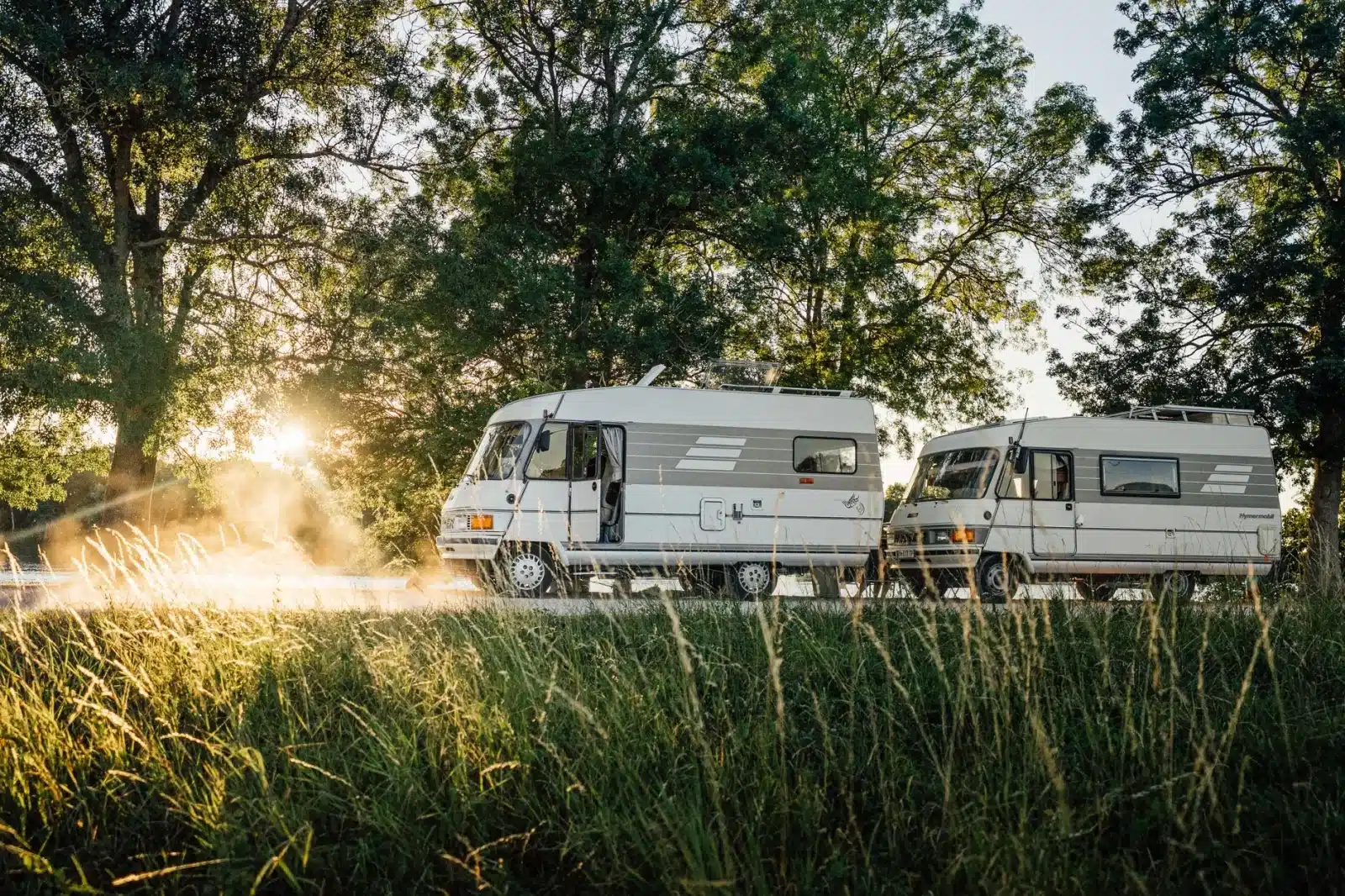
The campervan rental market has grown significantly in recent years, offering more options to test a layout before buying or to travel without committing to a purchase. Then comes the route question: dedicated maps, stopover area (aire de service) apps and feedback from other travellers save valuable time compared to total improvisation. Between free areas with no services, paid areas with water and electricity, and isolated waste-disposal points, the choice makes a real difference to trip comfort—especially on a multi-week journey. It’s worth planning ahead, season by season, rather than discovering the options on the spot.
Maintenance and winter storage: plan ahead before things break down
A warning light on the motorway, 200 km from the next approved garage, can quickly ruin a summer. On motorhomes and campervans with recent diesel engines, three areas account for most recurring breakdowns: the variable timing and valve adjustment, the turbo with its electric wastegate, and the wheel-speed sensors linked to the ABS.

Not all these faults are equally serious. A faulty wastegate solenoid or a clogged automatic gearbox can immobilise the vehicle immediately, whereas an EGR valve or secondary air-valve issue often just triggers a warning light with no immediate impact on driving. Before winter storage, the checklist not to skip comes down to three key steps: drain the fresh-water and waste-water systems to prevent freezing, disconnect or maintain the leisure battery, and turn off the gas supply if the vehicle won’t be used for several months. These checks—before setting off and on return—prevent most breakdowns that strand a motorhome mid-season.
Motorhome or fitted campervan: which vehicle for which use
The question comes up every time you hesitate between the two: a campervan is chosen for frequent short trips and parking freedom, a motorhome for living space on long stays. A couple who go away for three weeks in summer and never the rest of the year won’t have the same needs as a remote worker who spends every weekend on the road from a big city.
| Criteria | Fitted campervan | Motorhome |
|---|---|---|
| Urban parking | Standard space | Often needs dedicated parking |
| Fixed berths | Usually 2 | 4 to 6 depending on model |
| Typical use | Frequent weekends, short trips | Long stays, touring |
| Winter insulation | Varies by fit-out | Generally better |
The mistakes that cost the most before your first trip
Some mistakes crop up whatever the traveller’s profile or starting budget—and often end up costing far more than they would have to prevent.
- Choosing the vehicle based on the sticker price without checking the real cost of transferring the registration certificate (carte grise) or the first few years’ insurance.
- Overlooking breakdown cover abroad, which is often limited or charged as an optional extra on entry-level policies.
- Setting off without checking the date of the last MOT (contrôle technique)—a common reason for administrative hold-ups after purchase.
- Improvising a summer route without scouting at least a few stopover areas (aires d’étape) or overnight parking spots in advance, especially in busy areas.
- Putting off engine maintenance from one season to the next, when a warning light almost always signals something specific to check before hitting the road again.
- Skipping basic winter-storage steps (draining water, battery, gas) and discovering frost damage the following spring.